 MyGDC
MyGDC
Dental nurse education and training: beginning as we mean to go on
Dental nurses are by far the largest professional group on the register. More than half of all registrants are dental nurses, with almost 70,000 on the register in 2026.
There were 1.43 registered dental nurses for every dentist at the end of 2025, up from 1.33 a decade ago, perhaps demonstrating the essential role dental nurses play in patient safety, child oral health, community dental services and prevention.
Whatever the drivers, the numbers are big and getting bigger. We have nearly 10,000 aspiring dental nurses in training at any one time, and around 6,500 were added to the register in 2025. There are more than 100 training delivery sites, 50 organisations supporting apprenticeships and 10 qualification awarding bodies supporting the growing numbers of trainees across the UK.
The GDC is responsible for promoting high standards of education. Part of our public protection role is to ensure that only those who are suitably qualified are added to the register. We do that through a risk-based quality assurance system, which includes periodical thematic reviews; these were introduced in 2019.
Reviews are undertaken to explore any potential challenges or opportunities on a given topic or area. The most recent looked at dental nurse education and training.
Workplace-based delivery creates challenges
The results of the review were published in August 2026, and the report highlighted some important variations in assessment and learner experience.
The review concluded that while the system continues to produce safe and competent practitioners, the workplace-based delivery model used in dental nurse education and training creates points of potential vulnerability, at which the quality and consistency of education and training could be compromised. If we do not effectively minimise or mitigate these systemic vulnerabilities, cracks may begin to appear.
The system of dental nurse education and training has evolved over time and workplace-based delivery is its defining feature. That presents some unique challenges. It means regulatory oversight is a step removed and more complex. It can also create some tension between service delivery and educational needs.
The review highlights the following challenges:
- Reluctance to release dental nurse trainees for protected learning time and other members of the dental team for mentor training.
- Inconsistent wellbeing support for trainee dental nurses.
- Increasing adoption of remote learning and AI, driving concerns about engagement with learning and opportunities for hands-on experience.
- Potential for bias and inconsistency in the quality of assessments, linked to variable supervision, signing-off of competency by placement staff, not always having an external examiner present and unlimited resits.
These are areas that have been identified as in need of improvement. We are continuing to work with awarding bodies, providers and employers to address some of these inconsistencies, particularly to ensure the assessment process is robust. We will also be strengthening governance arrangements and our engagement with stakeholders to agree and address systemic issues.
Manjula Das, Head of Education Quality Assurance: “We’ve identified where we want to focus our collective efforts, and we’re looking forward to working more closely with our stakeholders to deliver change that will improve the experience of learners and trainers.
“Dental nurses are a vital and valuable part of the dental team, and we want to support the delivery of high-standard dental nurse education and training for the benefit of professionals and patients alike.”
Recent policy changes are further supporting the professionalisation of dental nursing. The length of time that a trainee dental nurse can work before starting a recognised training programme has been halved, from 24 to 12 months, in the interests of professionalism and public confidence. It is hoped that the change will encourage employers to commit to the development of dental nurse trainees by providing formal training earlier. The change took effect on 1 June 2026.
Significant improvements have also been made to the Scope of Practice Guidance, updated and reissued in 2025, to support professionalism and career progression. The additions include new supportive guidance on gaining and developing professional skills, abilities and competencies for each registrant group.
There are wider implications for dentistry
The variations in learner experience identified by the review have wider implications. Those representing dental nurses highlighted ongoing concerns about how some of these issues impact the retention of dental nurses. While pay and conditions provide part of the picture, the landscape includes limited career progression and a lack of recognition for the contribution made by dental nurses.
The findings from the Dental Nurse Retention Survey 2023 indicate that job satisfaction, meaningful work, career structure and opportunities for professional progression are by far the most significant factors influencing the retention of dental nurses. Feelings about the relative importance of these factors will naturally start to be formed during a dental nurse’s initial education and training.
We took a closer look at registration data, looking for an indication of how long we are retaining dental nurses in the sector. The chart below shows the proportion of dental nurses who joined the register in 2015 and remained on the register in the subsequent years. The drop-off over a decade is dramatic.
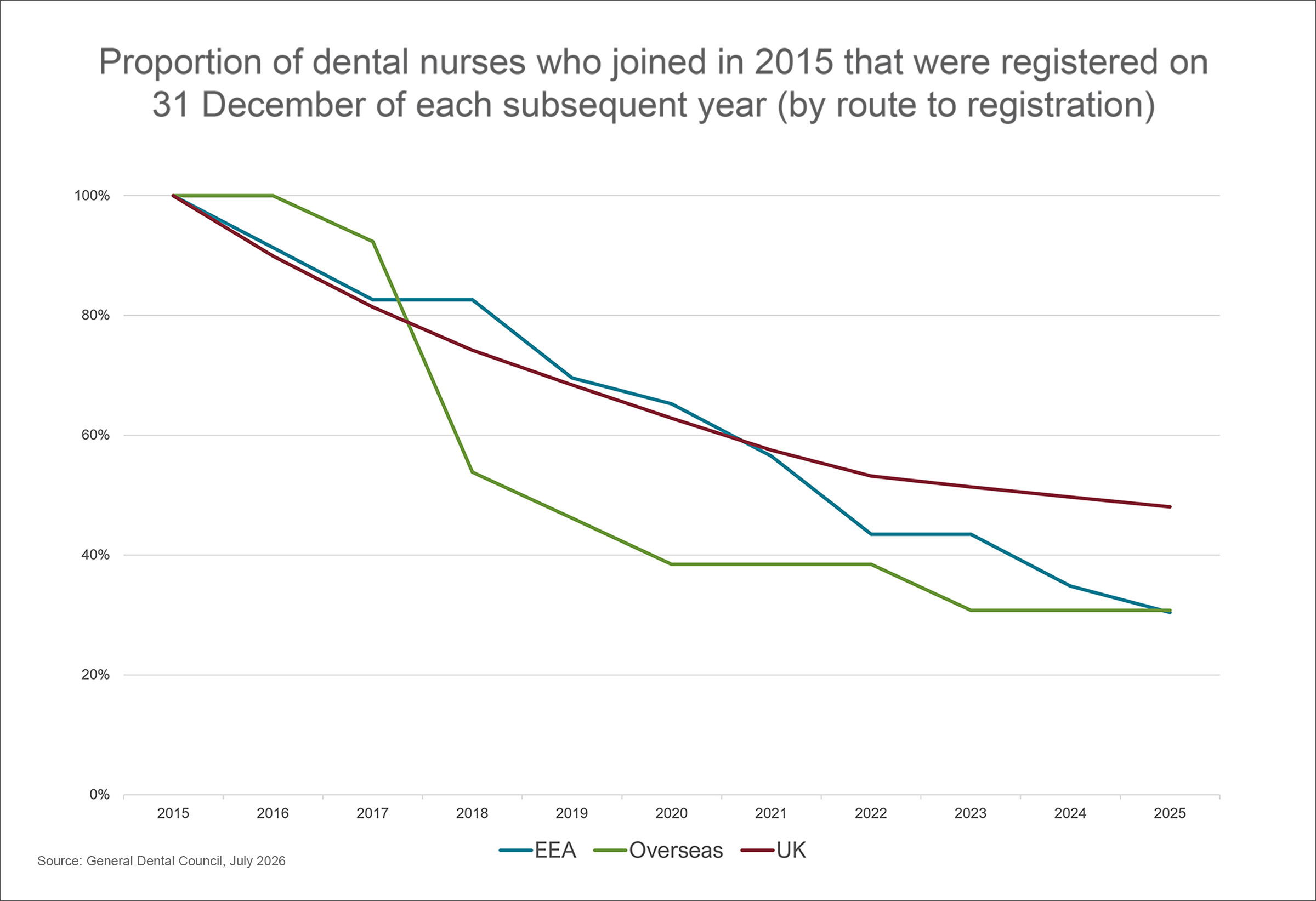
Dental nurses joining the register with a qualification gained in the UK is by far the largest group, and the data shows that over half of those who joined in 2015 had left the register by 2025. We considered the potential for changes in professional title, and made sure that those who remained on the dental care professional register under any title, were designated as retained.
These figures should give us pause for thought, particularly in light of the findings from the review, which indicate that the experience of learners is not always wholly positive. The requirement to continually train new dental nurses comes with both financial and opportunity costs, so improving the experience and support provided to dental nurse trainees has the potential to deliver long term benefits to the sector.
Kate Kerslake, Chief Executive Officer, National Examining Board for Dental Nurses, explains further: “The future strength of the dental nursing profession depends on consistent, high quality education that develops both competence and professionalism from the start of a learner's journey.
“By providing structured training programmes and raising awareness of the diverse career opportunities available within dental nursing, we can help build a more confident, skilled and sustainable workforce.”
Joined-up and targeted improvements are needed
The review of dental nurse education and training points to the areas where providers, employers and dental teams should focus efforts, such as ensuring consistent supervision and feedback. Releasing learners and mentors for training and assessment and ensuring access to wellbeing support will help protect the investment in education and training and perhaps retain more dental nurses.
Our working patterns data demonstrates the value of flexible working arrangements for many dental nurses, perhaps indicating the types of working arrangements that could further improve the retention of dental nurses.
The need to ensure that we have a sufficient number of dental nurses to support the growing number of dentists and to refocus efforts on preventative care have been a feature of stakeholder discussions on the future dental workforce. Slowing or arresting the number of dental nurses who leave dentistry each year, by improving the experience of those starting out, seems like something we can and should support.
We want to ensure that we have joined-up solutions to bring about change. We will play our part, by ensuring the quality assurance process continues to work effectively and that evidence-based improvements are made where needed.
We will continue to work with awarding bodies and providers to ensure that regulatory requirements are understood and consistently applied, and engage with stakeholders across the sector to ensure that we support wider efforts to improve the experience of all dental nurse trainees.
By taking a collaborative approach, we can all help to improve the experience of those joining the register as a dental nurse and support and nurture those seeking a career in dentistry.
Related content