 MyGDC
MyGDC
Changing profile of UK dentists
The number of dentists joining the register with an international qualification outnumbered those joining with a UK one for the first time in decades last year. This is a trend that is likely to continue, at least over the short to medium term. While UK undergraduate training places for dentists have received a recent increase in funding, exam capacity for overseas-qualified dentists is also set to increase sharply.
That poses questions for the sector, such as how to persuade and support newly registered dentists to provide NHS care, what types and levels of support to offer dentists from diverse backgrounds, and what else needs to be put in place to ensure the dental workforce can continue to meet population oral healthcare needs.
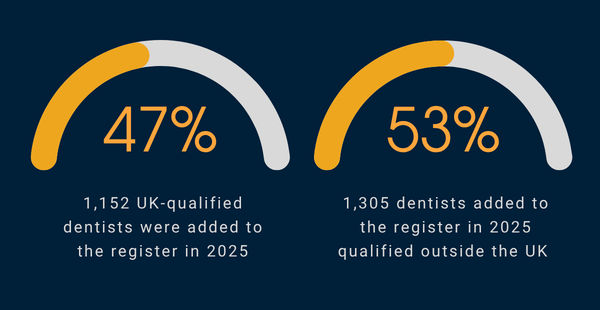
One of the significant drivers of this new trend has been demand for the Overseas Registration Examination (ORE). Over recent years the number of applications to sit the ORE has reached unpresented levels, with a 400% increase since 2022.
Ramping up ORE capacity has been a priority. New contracts for delivery of the ORE have been signed and capacity will increase flexibly in response to the number of candidates seeking a place. With our new provider in place, we could see a fivefold increase in the number of internationally-qualified dentists joining the register through this route.
Further exam capacity will also be provided by the Licence in Dental Surgery (LDS). The number of LDS places is set to grow from 180 to 1,800 by 2028 following confirmation of a one-off government grant for the Royal College of Surgeons of England. Other education providers have also expressed an interest in holding LDS exams, with Queen Mary University, London, securing programme approval in 2025.
Rapid expansion of exam sittings and providers comes with potential patient safety and public confidence risks, so we will be quality assuring the expansion and the new providers of LDS exams to ensure standards are maintained.
Alongside the expected increases in exam places for overseas-qualified dentists, are smaller scale increases to UK undergraduate dental training places, following recent government funding announcements. The new funding will provide for 50 more undergraduate places in England, rising to a total of 859 places per year from 2027/28, and 10 additional places in Scotland, increasing the number to 155 from 2026/27.
Two new dental schools were approved in 2024/25, at Portsmouth University and the University of East Anglia, and both schools now have dental authority status and approved undergraduate training programmes. While the allocation of places is yet to be announced, the Ministers responsible have asked for funding to go to schools not currently receiving financial support.
That will be welcome news for those looking to improve access to NHS dentistry in the areas that ultimately receive funding, as according to the Dental Schools Council, dental graduates tend to work close to where they grew up and analysis of working patterns data suggests that dentists are likely to be predominantly providing NHS care in the early years of their career.
The additional training places for UK dentists, combined with uplifts in ORE and LDS sittings will provide a much-welcome boost to the dental workforce. However, increasing the number of dentists on its own is unlikely to lead to significant improvements in access to NHS dentistry. The planned introduction of an NHS tie-in for graduating dentists who start courses from 2027/28 in England may help, but making the NHS a more attractive proposition and supporting access to performers lists will also be essential.
Dentists who are new to practising in the UK will need to be supported wherever they choose to practise. However, if access to NHS dentistry is to be significantly improved, priority must be given to encouraging and supporting overseas-qualified dentists to deliver NHS services, which will require more training and supervision.
Around a third of all UK registered dentists first qualified outside the UK, and we can expect that proportion to rise considerably over the coming years. Those who qualify overseas make an important and increasingly valuable contribution to the dental workforce and have the potential to make a significant contribution in improving access to NHS dentistry, with the necessary support.
Related content
GDC Registration Statistics Report 2025